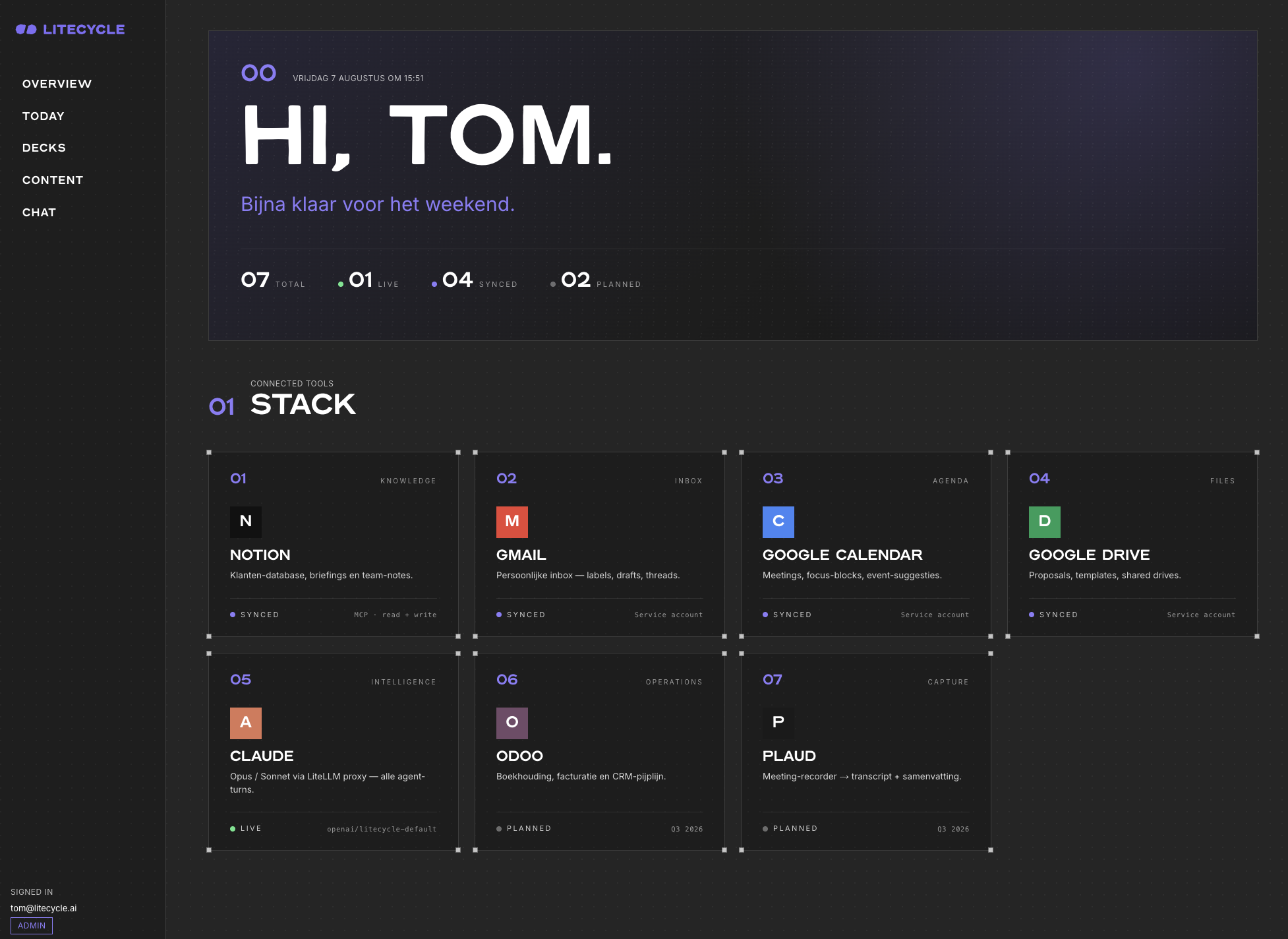
In two weeks, we connected our separate tools into one system. It chats with our ERP data, builds proposals from project data, turns meetings into tasks, and processes support tickets with the right project context included. This article describes how we approached it.
01 - Buy the foundation, build the connection
Five years ago, connecting two systems was a project with a budget and a supplier. Today, integrating systems is often plug and play, and the work is automated by AI agents.
Every SaaS tool solves one specific problem and brings three new ones with it: a login, a data silo, and an integration someone has to maintain. That is why we deliberately buy the foundation and build the layer on top ourselves.
02 - The foundation: our tool choices
Our foundation consists of systems we deliberately choose for their integrability.
Odoo Cloud as ERP backbone. The full cycle from customer quote to assignment, project management, and invoicing is organized in Odoo. The major advantage: Odoo is modular and highly integrable. This allows us to easily build custom connections, chat with our ERP data, generate custom reports for financial follow-up, build in our own time tracking, and configure customer portals exactly the way we want them.
Claude ecosystem for code, co-work, and design. Claude supports us in development, conceptual work, and design. Claude Code helps us move faster from idea to working solution, without having to go through a full traditional development cycle every time.
Notion for knowledge and preparation. All textual documents come together in Notion, which acts as the digital brain of our organization. We use real-time meeting transcripts, support for writing and improving texts, and even slide generation based on content. Notion also integrates smoothly with MCP and therefore with tools such as Claude, allowing content to move between systems.
Google Drive for document management. Google Drive remains our central place for documents, supported by Gemini and connected to the other tools.
Plaud as a physical recording device. Plaud is connected via MCP and is therefore accessible through the other tools. For every meeting, we have the raw recording, the transcript, and an AI summary in one central place.
Slack for team communication. Slack is connected to all the systems above and acts as a fast communication layer for the team. Through Claude Tag, we can coordinate Claude agents within our team channels.
That is the foundation. The layer on top we built ourselves.
03 - Litecycle OS: the core
On top of that foundation sits Litecycle OS, our own operating system. It brings all sources together into one core, to which we connect the systems we need. The result is data with context, which grows every day and which every component can connect to.
What runs on it today:
-
Chatting with our data across systems. A question about margins, project status, or what exactly was agreed with a client runs through one interface, using data from different systems: ERP data, meeting notes, mailbox, and other sources.
-
Proposal and pitch generation. Quotes and pitch decks are built from here: on-brand, based on project data that is already in the system. What used to take half a day of formatting work is now reduced to client-specific adjustments and review.
-
To-do orchestration. An agent reads calendar, mailbox, and personal notes, and turns them into a workable task list. You provide KPIs and objectives, so task priorities are set based on what has the most impact.
-
Content generation. Blog posts, LinkedIn content, and customer communication are prepared within our brand style, using project data and meeting notes as input. So we no longer start from a blank page.
-
Our own website. It was built with Claude Code on a modern stack with a headless CMS, fully managed in-house.
04 - What it delivers
-
Lower overhead. No manual information transfer between tools. Less time lost to fragmentation.
-
Faster and higher-quality output. Automatically from meeting to summary and action points. From project data to quote without formatting work. Data from different sources is no longer scattered, but centrally accessible.
-
More agility. When our needs change, we can quickly adapt our systems ourselves.
05 - Memory is the slow part
The connections were in place in two weeks. What flows through them needs years.
An AI system can only reason based on what has been written down. What remains in people’s heads, phone calls, and hallway conversations does not exist for the model. That sounds obvious until you try it. Most organizations that set out to do something with AI on their own data discover at that point that there is hardly any. Thousands of emails, but not a single decision with the reasoning behind it written down anywhere.
That is why our stack includes a recording device and every meeting is transcribed. Not because we reread those transcripts, but because they will still be there two years from now. It is the same reason why proposal preparation, project follow-up, and the reasoning behind a decision end up in Notion instead of in a conversation.
A knowledge base built over years contains the context of every project, every customer meeting, and every decision you ever made. When that becomes structured, searchable, and queryable by an AI agent, that is where the return lies. You cannot catch up on that difference later by working harder, only by having started earlier.
06 - What this means for your organization
The concrete tool choices above are based on our context. But the way of thinking is transferable and relevant to every organization:
- Choose systems based on integrability, not only functionality.
- Build the connecting layer yourself. That is where the differentiation lies, not in the tools underneath.
- Start small, measure the result, and expand process by process.
Connecting the tools costs you a week. The memory starts today.
Curious where that starts for you? Book a 30-minute call.