Phimex processes customs files 70% faster with AI
From 10 to 15 minutes down to 2 to 5 minutes per file.
- 2 to 5 minutes per file, previously 10 to 15
- 300+ files per month through the AI Document Processor
- Live within 3 months of the kick-off
Phimex Douane Expediteurs is an independent, neutral customs broker in Waddinxveen, the Netherlands. The team handles import, export and transit, and helps clients with NVWA inspections, transport and certificates of origin.
Together with Softpak, Litecycle built an AI Document Processor for Phimex. It reads the documents of a shipment and prepares the file in Softpak.
The challenge: every file started with retyping
Every shipment comes with a stack of documents. Invoice, packing list, bill of lading and, depending on the goods, phytosanitary, health or catch certificates. Digital or scanned, sometimes all in one PDF, and every supplier with its own layout.
Staff retyped everything: parties, delivery terms, weights, container numbers, seals, commodity codes. A shipment with five containers meant five declarations. A single file easily took 10 to 15 minutes, and any error could block the declaration.
More shipments meant more typing. And less time for what a customs specialist is really there for: assessing exceptions, checking and helping clients.
The solution: AI does the typing, the specialist decides
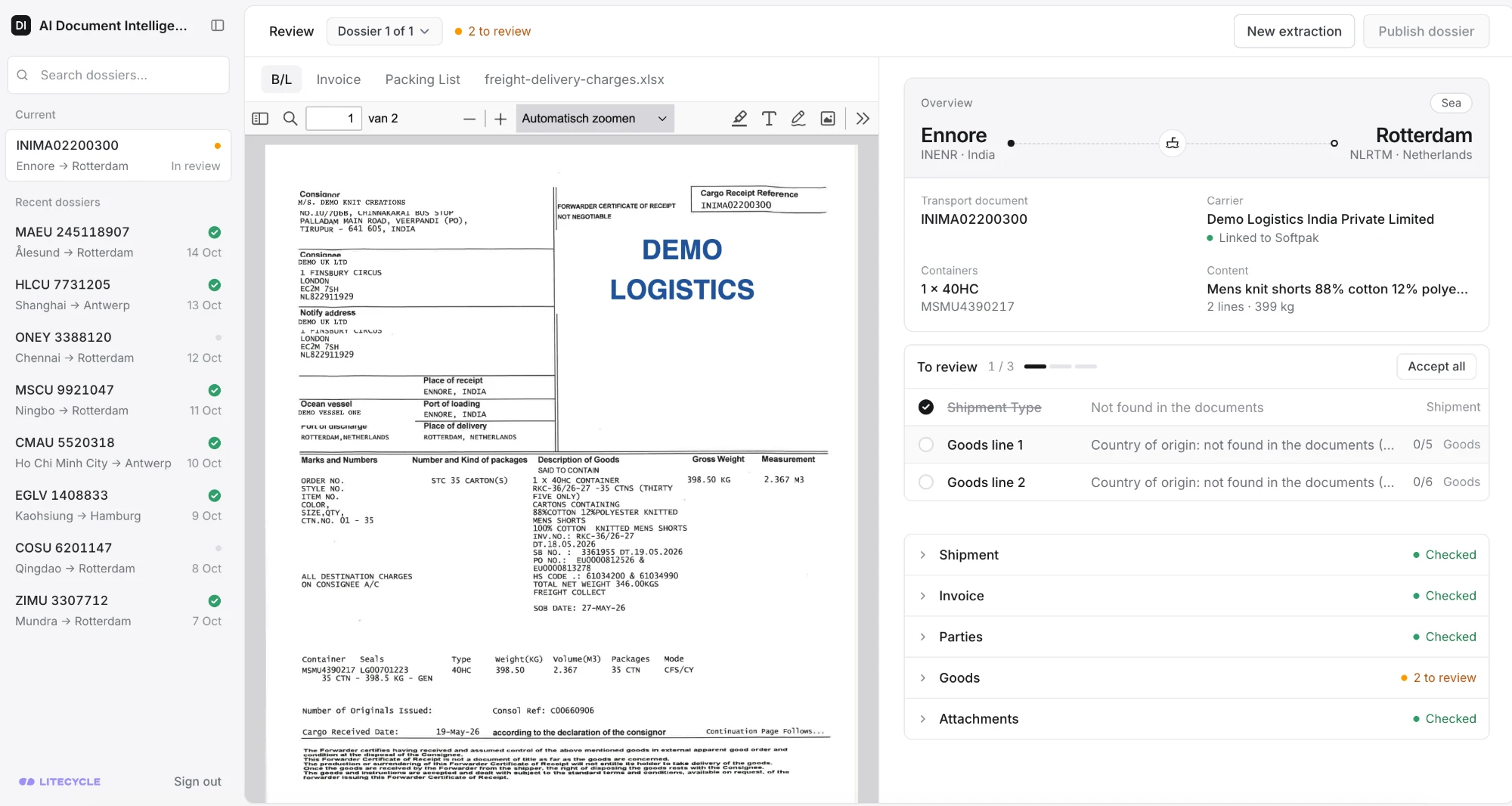
The AI Document Processor takes over the retyping. The customs specialist checks and decides what goes into the software system. The tool:
- recognises and separates the documents of a shipment, even when they are in a single scan;
- extracts the required fields, each with a confidence score and its source: file, page and location on the document;
- builds the shipment as one file, with an item and a declaration per container;
- flags doubtful cases, for example a supplier commodity code that doesn’t match the correct EU code;
- sends the file to the software system (Softpak) in one click once approved.
Corrections by the team are fed back. That way the processing keeps getting better at handling Phimex’s suppliers, layouts and exceptions.
The approach: start small, measure hard
We started with a pilot phase. Together with Phimex we mapped seven real shipments, from a single invoice with one container to shared containers, air freight and files with dozens of invoices. The validation phase deliberately focused on what occurs most often: sea freight with one, two or five containers.
After a go/no-go came phase 2: making it production-ready and testing it against a reference set of real files. The bar was set upfront: at least 90% of critical fields processed correctly.
The solution went live within three months of the kick-off. Phimex brought the customs expertise, Softpak the knowledge of its own platform, Litecycle the AI.
The results
70% less processing time. A file now takes 2 to 5 minutes instead of 10 to 15. The remaining time goes mostly to checking the extracted data.
More than 300 files per month run through the AI Document Processor today. That number grows as more document flows are added.
Fewer typos and less rework. Manual entry has largely disappeared, and with it the risk of errors in declarations.
Why this works
Reading a document is the easy part. The real complexity lies in the customs logic. Which commodity code applies in the EU? Which supporting documents belong to which product? How do you split a shipment across containers? And how does all of that end up in Softpak without errors?
That’s where the combination of customs expertise, platform knowledge and AI makes the difference. Not just pulling data out of a document, but data that is immediately usable in day-to-day file processing.
Phimex on the collaboration
“With Litecycle’s AI Document Processor we process files faster, more efficiently and with high accuracy. With the reforms in the customs world, digitalisation is becoming ever more important. Thanks to Litecycle, we are already building the customs processes of tomorrow.”
Amanda Boin, Managing Director, Phimex Douane Expediteurs
Is your team still retyping invoices, packing lists and certificates? Book a 30-minute call and we’ll look together at where the time savings are.